Owkin K Pro: What Sanofi Actually Bought
On 5 June 2026, Owkin announced a five-year licence with Sanofi for software called K Pro. AstraZeneca’s three-year one came on 13 May 2026, and Bristol Myers Squibb, Boehringer Ingelheim and Servier are on the list too. Five large buyers in one window can mean five independent verdicts on quality, or that nobody wants to be the one who didn’t buy an option.
I wanted to know what they bought, so I read Owkin’s documentation, found the papers underneath it, then signed in and ran the flagship example from their own docs.
The moat is the data, not the agent
K Pro is an agent that reads biological evidence and argues for a drug target.
The agent layer is good. It behaved better than I expected, and I’ll show you the transcript. But it isn’t what Sanofi bought. The moat is the data, and the best moment in my session was the system saying so itself.
What K Pro promises
You give K Pro a disease and a question in plain English. Back comes an interactive chart, a set of numbers, and a written argument with its sources attached.
Inside, it picks which data to query, writes the query, runs it and interprets the result. What it optimises for, in Owkin’s framing, is the time between a question and a defensible answer. Their headline claim: target identification drops from twelve-plus months to three.
Hold that number. I’ll come back to it.
Why naive target discovery fails
Here’s the naive version of target discovery, and it’s roughly what the field did for fifteen years.
Take a few hundred tumours, in practice TCGA, the public atlas NCI describes as “over 20,000 primary cancer and matched normal samples”. Measure how much of every gene each tumour is making. Compare the patients who did badly against those who did well. The genes that differ are your candidates.
This breaks in a specific and humiliating way.
In 2011, Venet, Dumont and Detours tested random gene sets, chosen with no biological thought at all, against breast cancer outcome. Sizing each random set to match a real MSigDB c2 pathway signature, 77% came out associated with outcome at p<0.05. Among random sets larger than 100 genes, more than 90% did. Separately, of 47 published prognostic signatures, only 18 beat the best 5% of a thousand random signatures of identical size.
The reason: a tumour sample isn’t a bag of tumour cells. It’s tumour plus immune cells plus connective tissue, in a ratio that varies wildly between patients. A gene that looks like a marker of aggressive cancer is often a marker of how much immune tissue landed in the tube. Aran and colleagues quantified this across TCGA in 2015.
So the question isn’t whether a system can find genes associated with outcome. Anything can, including chance. It’s whether it finds the ones about the tumour.
That’s what the multimodal pitch is for. See which cell type a gene is expressed in and the confound goes away. But single-cell and spatial data at scale is expensive, slow and mostly not public, which is where the moat comes from.
Six components, and the model that isn’t on the list
When I read it on 16 September, Owkin described K Pro as “a single intelligent orchestrator that dynamically selects and combines specialized AI skills”. Underneath that, six named components:
- LLM reasoning. Swappable, and the vendor isn’t named on the page.
- Tools and data through an MCP gateway. Model Context Protocol is the now-standard way to plug tools into an agent, the same plumbing you’d use anywhere.
- Skills. Expert-written procedures in three tiers: Owkin-certified, KOL-derived, customer-authored.
- A sandboxed code executor.
- Parallel autonomous sub-agents, for running many analyses at once.
- ISO27001 and GDPR compliant deployment.
The skill tiers are named on a separate page, not this one. And note the sixth slot: in a six-item architecture for a biological reasoning product, the last item was a compliance certification.
Owkin has since rewritten the page. By 22 October it called K Pro “an agentic harness designed for intelligence, reliability and interoperability”, the six components ended with “Multiple agents”, and the compliance line had moved to a separate list. One thing hadn’t changed: the reasoning layer is still “a state-of-the-art enterprise LLM” that “can be substituted according to need”, and Owkin’s own reasoning model isn’t on the page.
That model is worth pausing on, so I pulled it from where they do document it: 8B to 32B models post-trained from Qwen3 on 300,000-plus verified question-and-answer pairs using reinforcement learning from verifiable rewards. In other words, they took an open-weights model and trained it further on biology questions where the answer can be checked automatically.
The three ways you drive it sit on a spectrum of how much control you keep:
| Mode | What you do | What runs |
|---|---|---|
| Co-pilot | Ask in plain English, then drill into the chart | One analysis, conversational |
| Skills | Type /target-characterization NECTIN4 in BLCA |
A certified multi-step procedure |
| Campaigns | Set parameters and walk away | Many sandboxed agents in parallel, results aggregated |
In none of them do you write code or name a dataset. That’s the product: a no-code surface over data most people can’t get.
I ran Owkin’s own flagship prompt
Owkin’s documentation has a flagship example. I typed it in exactly as written, on the free tier:
Show me NECTIN4 expression across malignant cell types in MOSAIC bladder cancer cohorts, compare to GTEx healthy tissues.
The reasoning trace is worth reading, because it hits a wall almost immediately:
Now I need to look at what MOSAIC data is available. I don’t see MOSAIC listed in the datasets. The server shows: cptac, gtex, tcga.
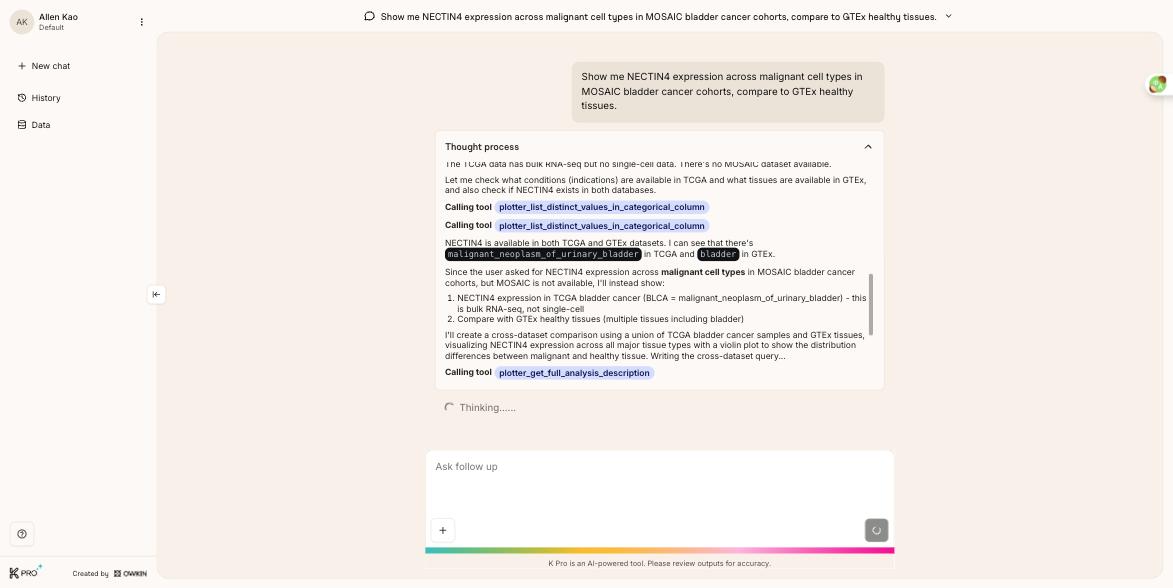
MOSAIC is the proprietary cohort, and it isn’t on the free tier. What happened next I didn’t expect.
It didn’t fake it, and it didn’t quietly substitute and hope. It put a warning above the answer, before any result:
Important Caveat, MOSAIC Not Available. MOSAIC is not available on this server. The analysis was performed using TCGA bulk RNA-seq (BLCA, the bladder cancer cohort, n=414 primary/metastatic tumor samples) as the tumor comparator, and GTEx healthy tissues (n=971 samples across 30 tissues, filtered for perc_mt < 20%) as the normal reference. Cell-type-level single-cell resolution is not available here; expression reflects the bulk tumor transcriptome.
Then it ran what it could. NECTIN4 in bladder tumours: n=414, mean 6.43 on a log scale where each step is a doubling, median 6.79, a tight distribution with essentially no zero-expressing samples. Against healthy bladder at 3.30, that’s roughly an eight-fold elevation.
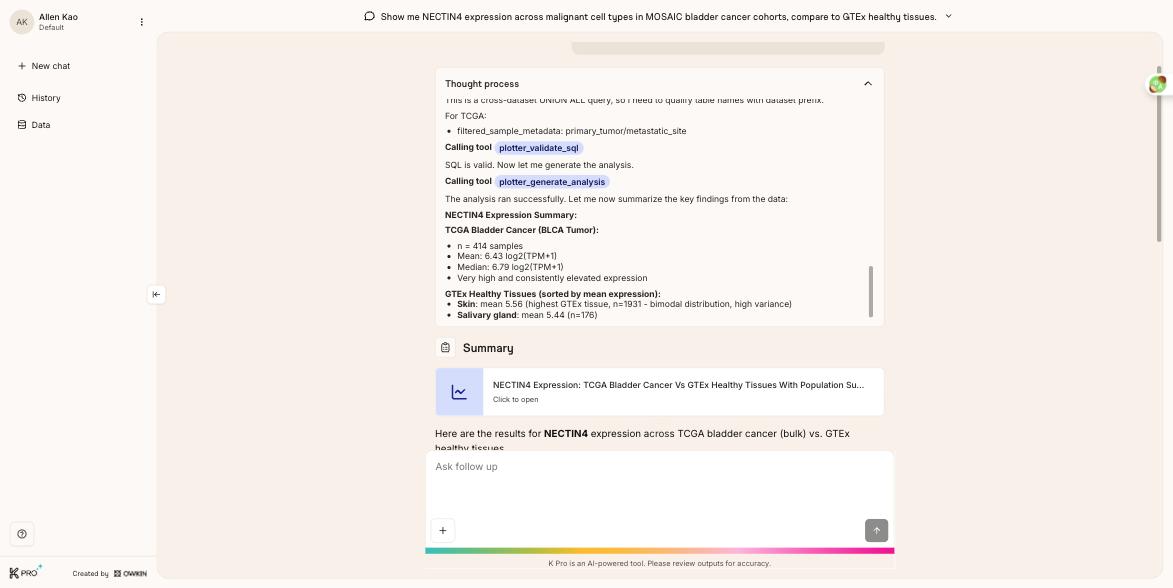
The system labelled its cohort “primary/metastatic”, which sounds like a mixture worth worrying about. NCI’s GDC data gives TCGA-BLCA as 412 primary and 1 metastatic, so the confound is one sample in 413. I’d written a paragraph on why it mattered before I looked.
The check turned up something smaller: the tool said 414, the GDC says 413. One sample, on the first number it showed me, in the cohort it chose itself. Nobody should build anything on that gap. It matters only because this is a post about whether these systems’ numbers match their sources, and here they didn’t, by one.
Then it did something I’d want from a junior analyst and wouldn’t assume of a chatbot. It looked at where else NECTIN4 runs high in healthy tissue: skin 5.56, vagina 5.49, salivary gland 5.44. Then it connected that to the clinic:
consistent with its established role as a therapeutic target for enfortumab vedotin. The high expression in skin and salivary gland healthy tissues aligns with known dermatologic adverse events reported for this ADC
An ADC is an antibody-drug conjugate: an antibody that carries a toxin to whatever it binds. The tool is right. Enfortumab vedotin is an approved ADC against NECTIN4 in urothelial cancer, and skin toxicity is its signature side effect. It went from an expression table to a clinical consequence unprompted.
And it closed by naming its own moat:
To replicate this in MOSAIC single-cell data, MOSAIC access would be required to decompose expression by cell type.
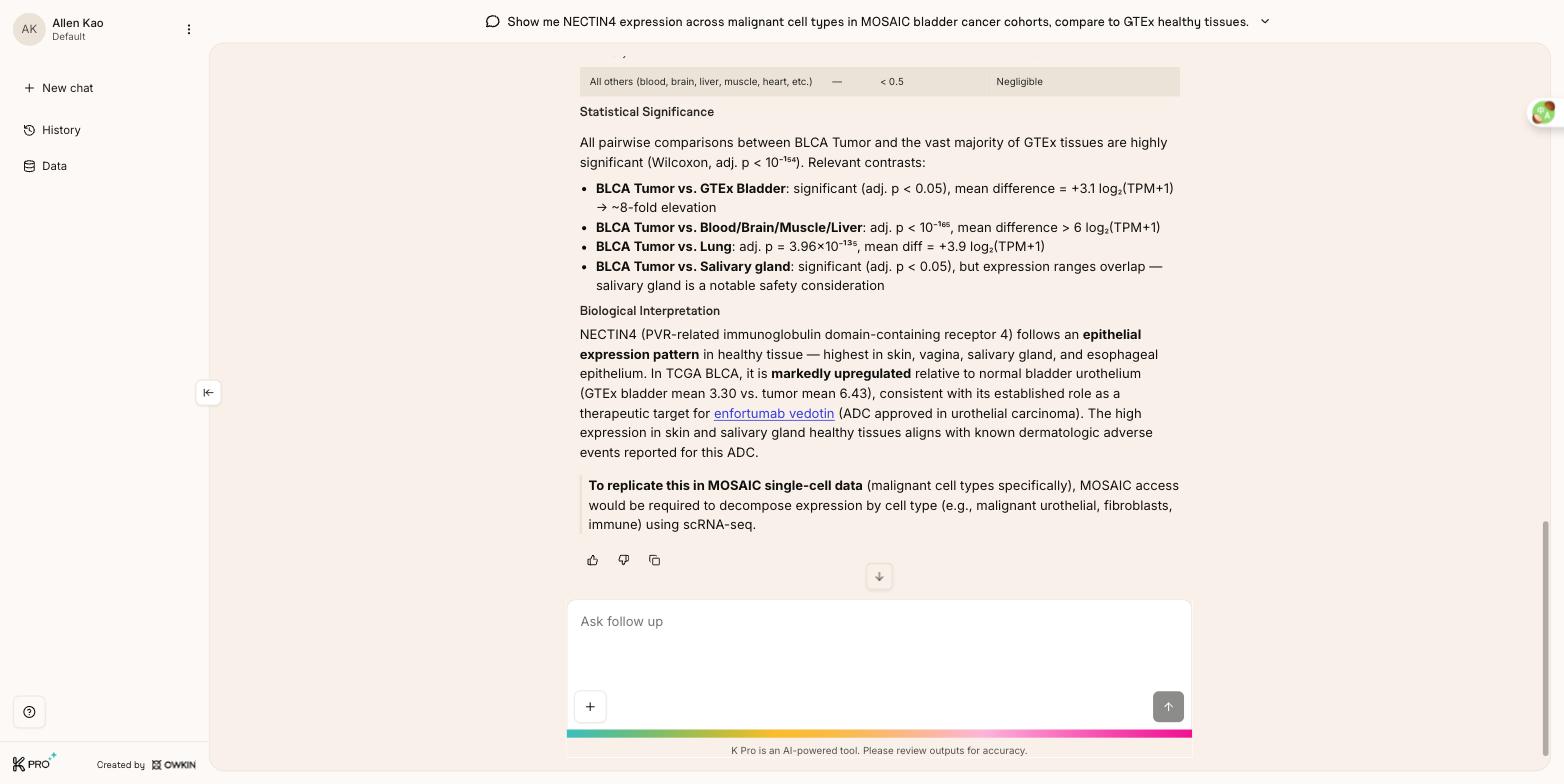
That sentence is the whole business model, written by the product, unprompted.
What this run doesn’t show. One mode, one question, and the only failure was a dataset plainly absent. That’s the easy failure. The interesting one is Campaigns mode, where many sub-agents run in parallel: what happens when two disagree, or one errors out halfway. I couldn’t test that, and Owkin hasn’t published it. Read the transcript as evidence about the conversational surface, nothing else.
The agent is good at what I could see. The agent is also not the thing you’re paying for.
Two objections
“Isn’t ‘agentic’ just a wrapper?” Not entirely: there’s a named architecture, a domain-post-trained model rather than an API call to a general one, and proprietary data behind the tool calls. But three differences in the build aren’t three in the output. Every number Owkin publishes measures the model, on static question sets. Nothing measures the orchestrator. No ablation shows multi-step orchestration beating a single call to the same model with the same data. Until one exists, “agentic” describes the architecture, not a capability. If it existed, it would be the headline.
“Surely the pharma deals prove it works.” They prove a procurement decision happened. Look at what the announcements disclose.
Neither the Sanofi nor the AstraZeneca release gives a value, a milestone structure, a performance gate or a termination term. Boehringer Ingelheim’s is undisclosed too. What’s public is a term length and a logo.
That matters, because two questions decide whether this is a moat or a good subscription business, and neither is answered anywhere:
- Is access exclusive by indication? If Owkin can license the same MOSAIC data to every large-cap in oncology, each licensee bought a capability, not an advantage over the others who bought it too.
- Does partner data flow back into MOSAIC? If so, every signature enlarges the asset and the moat compounds. If not, the cohort is fixed and a well-funded competitor can eventually match it.
I couldn’t find an answer to either, and they’re the first two I’d ask. Exscientia’s SEC filing discloses that Sanofi could terminate their collaboration “for any reason or no reason”. BenevolentAI ran five years with AstraZeneca, hit seven milestones, generated about £32M, then saw revenue fall 46% as target identification wound down, and delisted from Euronext Amsterdam in March 2025. A partnership that met its stated goals and ended anyway.
Where the claims outrun the evidence
Every layer is published except K Pro
| Layer | What it is | Status |
|---|---|---|
| iBOT | Self-supervised vision method | Peer reviewed, ICLR 2022 |
| Phikon / Phikon-v2 | Pathology encoders on TCGA tiles | Preprint only |
| H0-mini | Distilled backbone, built with DINO and iBOT, two self-supervised methods | Peer reviewed, MICCAI 2025 |
| HistoPLUS | Cell typing, 13 types, 108,722 nuclei | Peer reviewed, J Pathol Inform 2026 |
| MOSAIC | The multimodal cohort | Preprint only, bioRxiv 2025 |
| Owkin Zero | The reasoning model | Preprint only, arXiv 2025 |
| K Pro | The product | Nothing |
I searched hard for an evaluation of K Pro as a system, peer reviewed or preprint. There’s none. What exists is component evaluation, vendor methodology shared through press, and adoption used as validation.
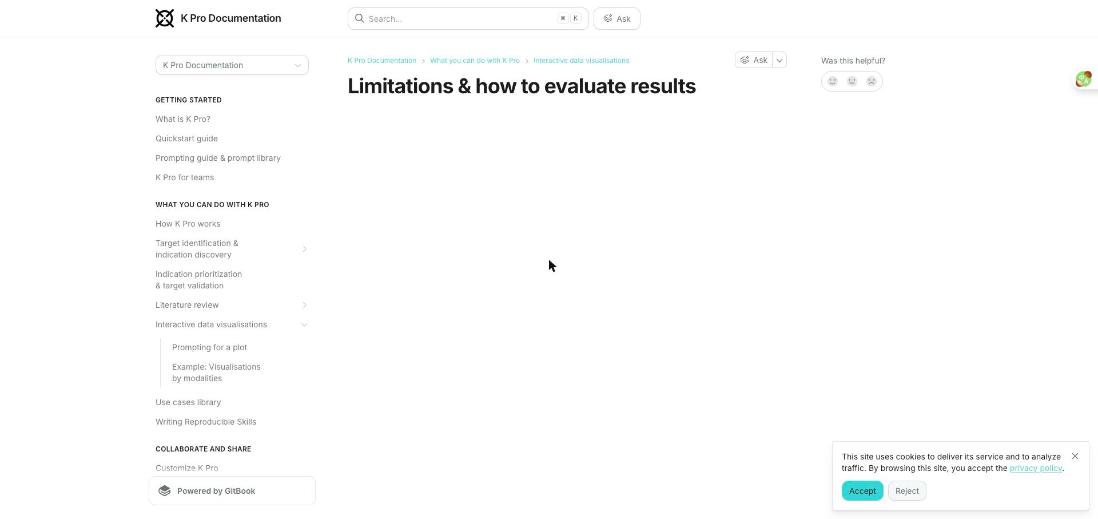
Owkin’s documentation has a page titled “Limitations & how to evaluate results”. As of 16 September 2026 it was empty. Just the heading.
The numbers disagree with each other
Not with critics. With Owkin.
| Claim | Owkin says | Also Owkin says |
|---|---|---|
| MOSAIC size | 2,700 samples, 11 tumour types (product page) | 7,000 patients, 7 indications (data page). The FAQ says 2,600 patients, 10 indications |
| HistoPLUS F1 gain | 14% over prior state of the art (docs) | 23.7%, with 5.2% detection gain, on external validation across four cohorts (the paper) |
| Owkin Zero training data | About 10M curated Q&A pairs (docs) | 300,000-plus verifiable pairs (product page and paper) |
None of these is necessarily a lie. The F1 figure may be a different split; the 10M may count pairs generated before filtering to the verifiable 300k. But the docs give no method, so a reader can’t tell. The public MOSAIC subset is 60 patients across five cancer types.
The headline numbers have no denominator
Target ID accelerated 70%, twelve-plus months to three. Trial duration cut 35%. IND-ready positioning in hours, meaning the package filed before a drug may be tested in humans. All three appear only in the October 2025 launch release: no evaluation method, no baseline, no sample size.
The paper is more honest than the marketing
This is the part I didn’t expect, and it raised my opinion of the team. The Owkin Zero authors report, in their own preprint:
- Catastrophic forgetting. On the held-out Structural Druggability task their 8B scores 55.5 against 70.0 for the base Qwen3-8B it came from; the 32B drops too, 71.92 against 78.33. Post-training made both worse at a nearby task, and the paper says so: “base models perform better than our OwkinZero models on the out-of-domain task”.
- One benchmark “remains unsolved, raising the question of whether there is any signal in the Q&A data”.
- Training on accuracy is “insufficient on its own to guarantee faithful reasoning”, and their mixture training “improved overall accuracy at the cost of reasoning faithfulness”.
- Their reasoning-quality scores are “anecdotal at this stage”.
- Multiple choice “is also a limiting factor”.
Their aggregate column, labelled only “All” and never defined as a mean: Owkin Zero 32B 78.37, Qwen3-32B base 60.24, DeepSeek-R1 59.5, o3-mini 55.08, GPT-4o 52.32. On one task the two OpenAI models score 10.5 and 9.6 because refusals count as failures, which flatters the gap.
The base rate that matters most
Jayatunga and colleagues tracked AI-discovered molecules through the clinic. Their abstract is worth quoting exactly, because the two halves point in opposite directions:
In Phase I we find AI-discovered molecules have an 80-90% success rate, substantially higher than historic industry averages… In Phase II the success rate is ~40%, albeit on a limited sample size, comparable to historic industry averages.
FDA describes Phase 1 as testing “safety and dosage”, Phase 2 as “efficacy and side effects”. Reading the second as the trial that finds out whether the target was right is my gloss, not FDA’s, but it’s why the split matters: the measured advantage sits in the phase that doesn’t ask the question K Pro exists to answer.
One caveat I can state but not resolve: the full text sits behind a paywall, so the baseline percentages and cohort size are in tables I haven’t read. The abstract says only “limited sample size”, and everything above is quoted from it.
For agents doing bioinformatics specifically, BixBench ran frontier models against “61 real-world analytical scenarios or ‘capsules’ with 205 associated open-answer questions”. The best reached 21% on open answers, near random on multiple choice. Scores rose when the abstain option was removed, which the authors read as models answering from memory rather than from the analysis they’d just run. K Pro may beat that. Nobody has shown it.
That paper’s abstract still advertises “over 50” scenarios and 17% accuracy, figures its own revised body no longer supports. I quoted the abstract here before reading the body. The problem isn’t confined to vendors.
The test that would settle it
With access and a week, one experiment settles more than any benchmark:
Deposit K Pro’s ranked target list for one indication, timestamped, before any validation work. Then report the hit rate against a preregistered criterion, alongside two comparators: a size-matched random gene set, and a standard Open Targets ranking on that indication.
That’s the Venet test: the only design that speaks to target quality rather than speed, and Owkin could run it with data they hold.
They’ve run something close to this, and it would be unfair not to say so. For Discovery AI, a different product, Owkin published a comparison against the comparators I just asked for: “lift, defined as the ratio of Owkin’s Discovery AI AUC-PR to the baseline models”, 19.6× over random and 2.8× over Open Targets, across six indications, scored against targets that reached phase II. That’s more than most of this field publishes.
Three limits. It isn’t K Pro. It’s retrospective, scored against targets already known to have reached phase II, which isn’t the same as depositing a list and waiting. And they modified the comparator: “we excluded all associations sourced from literature and ChEMBL to avoid potential data leakage”. Defensible, arguably necessary, and it still means the 2.8× is measured against a weakened Open Targets rather than the one a customer would use. They say so plainly, to their credit, and it’s exactly the detail that falls off when a number gets quoted onward.
So the gap is narrower than I first wrote it, and it still sits where the product is.
Cheaper disclosures would move me almost as much. Name the journal and DOI of the review K Pro drafted in a day. Publish the denominator behind the 70%. Say whether the 35% figure is observed or simulated.
The tell to watch isn’t another launch partnership but a renewal with disclosed economics, or a partner publishing its own evaluation.
What a five-year licence buys
The science under K Pro is real and most of it is published. The integrated product has no published evaluation, and the agent layer, on the free tier, told me what it couldn’t do and why, which is more than most systems manage.
What makes K Pro different from a good open-source agent isn’t the agent. It’s 2,700 samples, or 7,000 patients, or 2,600 patients, depending which page you read. I mislabelled the first as patients in an earlier draft of this sentence, which shows how fast a unit slips once a number is loose. That’s what a five-year licence buys.
Claims ledger
Every load-bearing claim, where it came from, and how far I checked it.
The distinction that matters in a post about evidence standards is how a claim was checked, not just whether a source exists. Three levels appear below: read at source and quoted; read at source by a research assistant with the quote on file; and unreachable, where a paywall or bot wall stopped me and I’ve said so rather than repeating a figure from secondary coverage. Anything marked vendor is Owkin’s own statement, repeated without independent verification, which is the whole point of separating it out.
Sixty-three statements in this post were put through that check before publication. Four didn’t survive it: two numbers were removed, one paraphrase was tightened to the source’s own criterion, and one aggregate was stripped of a property the paper never claimed for it.
- Sanofi five-year licence, 5 June 2026. Owkin press release. No value, milestones or termination terms disclosed. Primary source, terms not verifiable.
- AstraZeneca three-year licence, 13 May 2026. Owkin press release. Same gaps. Primary source.
- K Pro launched 16 October 2025. Owkin press release. Primary source.
- Six named components, single orchestrator, MCP gateway, sixth slot is a compliance certification. Owkin architecture page, JSON-LD feature list. Skill tiers are on the separate skills page. Read 16 September 2026; by 22 October the page had been rewritten, with compliance moved to a separate list. Vendor description, not independently inspected, and since changed.
- Owkin Zero: 8B to 32B, post-trained from Qwen3, 300,000-plus verified pairs, RLVR. Owkin product page and the arXiv preprint agree. Preprint, not peer reviewed.
- Owkin Zero benchmark averages and the catastrophic-forgetting result. From the preprint’s own tables and discussion. Self-reported, self-scored, no independent replication found.
- HistoPLUS: 13 cell types, 108,722 nuclei, +23.7% F1 and +5.2% detection on external validation across four cohorts. Journal of Pathology Informatics, 2026. Peer reviewed.
- The docs say 14% instead. docs.owkin.com, read 16 September 2026. Contradiction with the paper, no method given for either figure.
- MOSAIC sizes of 2,700 samples, 7,000 patients and 2,600 patients. Three different Owkin pages, all read 16 September 2026. Contradiction inside one vendor’s own site, and the unit moves too.
- No peer-reviewed or preprint evaluation of K Pro as a system. Searched arXiv, bioRxiv, medRxiv, PubMed and Crossref. Absence of evidence, not proof of absence, but I looked hard.
- The “Limitations & how to evaluate results” page is empty. Verified in the browser and by fetching the page source, 16 September 2026. Directly observed.
- The K Pro session: MOSAIC unavailable, the caveat, n=414, the GTEx figures, the enfortumab vedotin link. My own run on the free tier, 16 September 2026. Directly observed, single run, conversational mode only. The expression figures are that session’s output, not a citable dataset release; NCI’s GDC gives 412 primary plus 1 metastatic for the same cohort, against the tool’s 414.
- 77% of size-matched random gene sets, and over 90% of random sets above 100 genes, associate with breast cancer outcome; separately, 18 of 47 published signatures beat the best 5% of a thousand size-matched random sets. Two distinct analyses in Venet, Dumont and Detours, PLoS Computational Biology, 2011. Peer reviewed.
- Tumour purity confounds bulk expression across TCGA. Aran et al., Nature Communications, 2015. Peer reviewed.
- AI-discovered molecules: 80 to 90% Phase 1, about 40% Phase 2. Jayatunga et al., Drug Discovery Today, 2024. Quoted from the abstract. The full text is behind a paywall that blocked every route I tried, so the cohort size and the baseline percentages are unread at source and not quoted here.
- Frontier agents at 21% on open-ended bioinformatics analysis, 61 capsules and 205 questions. BixBench, arXiv 2503.00096 v3 body text. Preprint, and its own abstract still carries superseded figures.
- Sanofi could terminate the Exscientia collaboration “for any reason or no reason”. Exscientia SEC filing. Primary source.
- BenevolentAI: seven milestones, about £32M, revenue down 46%. Company interim results, June 2024. Delisting from Euronext Amsterdam, March 2025, a separate company announcement. Primary sources, two of them. The interim-results table shows -56% for the same revenue line the narrative calls 46%.
Two things I couldn’t check. I have no access to the paid tier, so Skills and Campaigns mode are described from Owkin’s documentation and weren’t exercised. And I found no answer to whether MOSAIC access is exclusive by indication, or whether partner data flows back into the cohort.
The Owkin documentation and product pages were read on 16 September 2026, and the K Pro session was run the same day on the free tier.